


Der Yacon Snack ist mit seiner natürlichen Süße richtig lecker. Da fällt es mir schwer, aufzuhören :-)
Weil der Yacon Snack so lecker ist, ist er leider schneller weg als mir lieb ist ;-)
Free shipping on orders over 100 EUR!


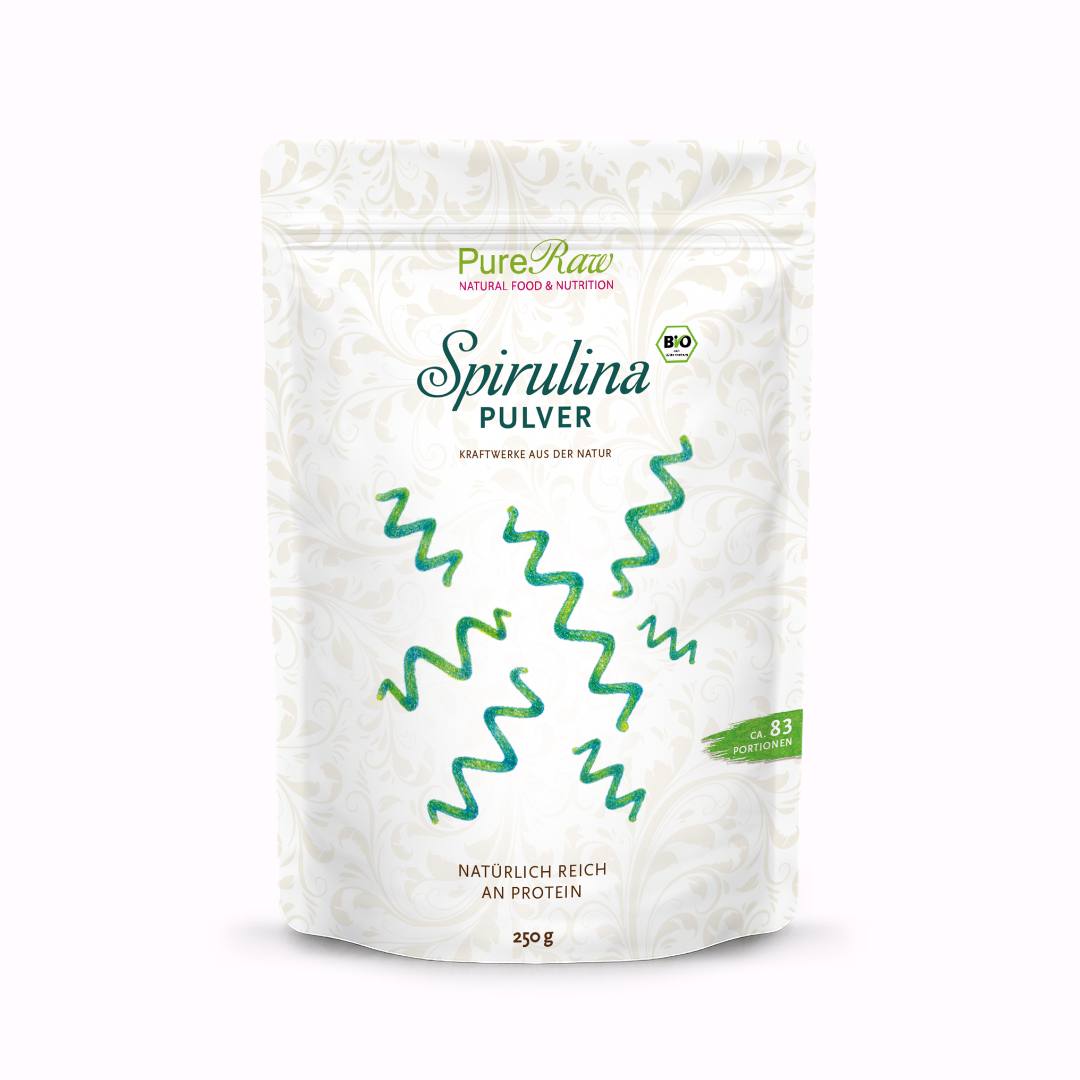
Answers to Spirulina
Spirulina is a microalgae, or more precisely a genus of cyanobacteria, that was formerly often referred to as "blue-green algae." It grows naturally in warm, mineral-rich waters and has been used for centuries as a nutrient-rich food source.
Since the end of 2015, the EU Organic Regulation has, in principle, allowed
the organic certification of microalgae. However, this process is challenging,
as it requires specific substrates (fertilizers). After extensive
testing, we have found that some of these substrates are either not
vegan or do not meet our high quality criteria. Additionally,
we would like to emphasize that transporting fertilizers like guano around the world
is neither vegan nor optimal for the algae and does not meet our
sustainability standards.
Despite the possibility of having our microalgae organically certified,
we have decided against it for now. This step ensures that all
substrates and processes we use comply with our own strict
quality standards. Your health and satisfaction, as well as the
high quality standard of our algae, are our top priority.
Our spirulina is grown in Germany. It is cultivated on small, family-run farms in the north of Germany.
The algae grow there in shallow basins inside a greenhouse. This allows for ideal growing conditions to be created and external contamination to be avoided as much as possible. The entire cultivation process is subject to constant quality controls.
The spirulina is harvested from the cultivation solution using fine-mesh nets and subsequently gently dried at approx. 42 °C. This gentle drying process supports the preservation of valuable nutrients and ensures quality at a raw food standard. No additives or processing aids are used.
Yes. Spirulina naturally contains plant-based protein and is therefore well-suited for a conscious, plant-based diet. Spirulina is particularly popular among people who want to supplement their smoothies, bowls, shakes, or pancakes with a nutrient-rich superfood.
Spirulina contains the concentrated power of the microalgae: plant-based protein, naturally occurring minerals, and valuable micronutrients. These include, among others, vitamin K1, potassium, iron, and phosphorus, embedded in a pure, natural superfood grown in Germany. Vitamin K contributes to normal blood clotting and the maintenance of normal bones.
Spirulina is frequently associated with vitamin B12. It is important to note, however, that Spirulina primarily contains so-called vitamin B12 analogues, also known as pseudo-vitamin B12. These forms are not considered a reliable source of vitamin B12 for humans.
For vitamin B12 supplementation, we therefore do not recommend Spirulina, but rather our specific German Chlorella. This has been analytically tested and is proven to contain bioactive vitamin B12.
Yes, in principle, both Spirulina and Chlorella can be part of a conscious diet. However, if your specific goal is to absorb bioavailable vitamin B12 from our German Chlorella, we recommend taking Chlorella and Spirulina at different times, ideally with at least a 30-minute interval.
The reason: Spirulina mainly contains pseudo-vitamin B12. These B12-like compounds cannot be reliably utilized by the human body and can be confused with active vitamin B12. Therefore, taking them separately is a sensible recommendation.
Spirulina and chlorella are both among the best-known microalgae, but differ significantly in their classification, composition, and taste.
Spirulina is a cyanobacterium and is particularly well-known as a plant-based protein source. It is therefore frequently valued in the sports sector and is popular for use in smoothies, bowls, shakes, or pancakes. In terms of taste, spirulina is usually somewhat milder, slightly algae-like, and delicately savory.
Chlorella is a green alga with a rigid cell structure and contains other characteristic ingredients. Our German chlorella is particularly associated with its high content of bioactive vitamin B12. In terms of taste, chlorella is bolder, greener, and somewhat more intense.
The recommended daily intake is:
4 g of spirulina powder per day, approx. 1 teaspoon.
Simply stir into a sufficient amount of liquid, blend, and consume promptly. Spirulina is particularly well-suited for smoothies, juices, shakes, or green bowls.
Spirulina has a typical algae-like, slightly savory taste. Our spirulina powder, grown in Germany, is of particularly high quality and pleasant in taste thanks to careful cultivation and processing.
In terms of flavor, spirulina goes particularly well with:
Tip: If you would like to use spirulina in a milder way, it is best combined with sweet fruits, cocoa, or coconut.
Spirulina powder is versatile and ideal for:
Spirulina also adds a special touch to homemade dressings or savory recipes.
In principle, spirulina can also be used in recipes such as pancakes or cakes. However, if you want to best preserve its raw food quality, we recommend using it in cold or only slightly warmed dishes, for example in smoothies, bowls, chia pudding, or dressings.
Yes, spirulina powder is excellent for smoothies. It tastes particularly harmonious in combination with banana, mango, apple, coconut drink, cocoa, or maca.
Simply blend approx. 1 teaspoon of spirulina powder with fruit, liquid, and other ingredients.
Yes. Our spirulina powder consists exclusively of:
Spirulina platensis powder
It contains no additives, no fillers, no flavorings, and no processing aids.
Spirulina can also be used in small amounts in recipes for children, for example in smoothies or pancakes. We recommend starting with approx. ½ teaspoon and monitoring tolerance. For very young children, if there are underlying medical conditions, or in case of any uncertainty, please consult a doctor beforehand.
The spirulina is harvested from the cultivation solution using fine-mesh nets and then gently dried at approx. 42 °C. This gentle drying process helps to preserve the valuable nutrients and ensures raw food quality.
The dried spirulina is then processed into tablets. We do not use any additives, fillers, or processing aids. This results in pure, high-quality spirulina tablets.
That depends on how you want to use spirulina. In terms of content, both versions are based on the same raw material: Spirulina platensis. This means that the characteristic nutrients of the spirulina remain essentially the same; it is primarily the dosage form that changes.
Spirulina powder is particularly well-suited for smoothies, shakes, bowls, pancakes, dressings, or creative recipes. It can be stirred directly into food and drinks.
Spirulina tablets are ideal if you want to take spirulina as easily and precisely dosed as possible. They are practical for when you are on the go, do not need to be stirred in, and are simply swallowed with sufficient liquid.
Der Yacon Snack ist mit seiner natürlichen Süße richtig lecker. Da fällt es mir schwer, aufzuhören :-)
Weil der Yacon Snack so lecker ist, ist er leider schneller weg als mir lieb ist ;-)
Tolle Chlorella Presslingen. Ich nehme sie für den täglichen Körperputz.
Ich nehme sie seit 2 Jahren ein und habe vor dies weiter zu tun....
super Qualität, super lecker und vielseitig zu verwenden
Super, kommt mit in den morgendlichen Joghurt
Eine sehr hochwertige Qualität von Chlorella Pulver. Ich wende es gerne als Darmkur an in Kombination mit Spirulina. Wegen der Nährstoffe ist es auch sehr besonders und dazu noch regional.
.... lecker, lecker, lecker ... mein Favorit bei natürlicher Süße ...
... leichte Zubereitung, auch mit dem Stabmixer ... schmeckt lecker ... mit mehr Crememigkeit wäre er noch leckerer ...
Prima Produkt in Deutschland zu fairem Preis hergestellt! Die Chlorellas bekommen mir sehr gut. Die Verpackung - wiederverschliessbarer Beutel- ist klein gehalten. Die Bestellung wurde schnell abgewickelt. Da bestelle ich gerne wieder.
Ich habe schon andere Ei-Ersatzprodukte zum Kuchenbacken benutzt, aber BOBEI ist eindeutig das Beste was mir bislang untergekommen ist!
Wunderbar!
Super lecker und dazu gesund. Kann man gut knabbern
Sehr hübsch :-)
Ich benutze Maca sehr gerne in Energieballs und Laddus.
.


