




About Vitamin B12, Chlorella Tablets
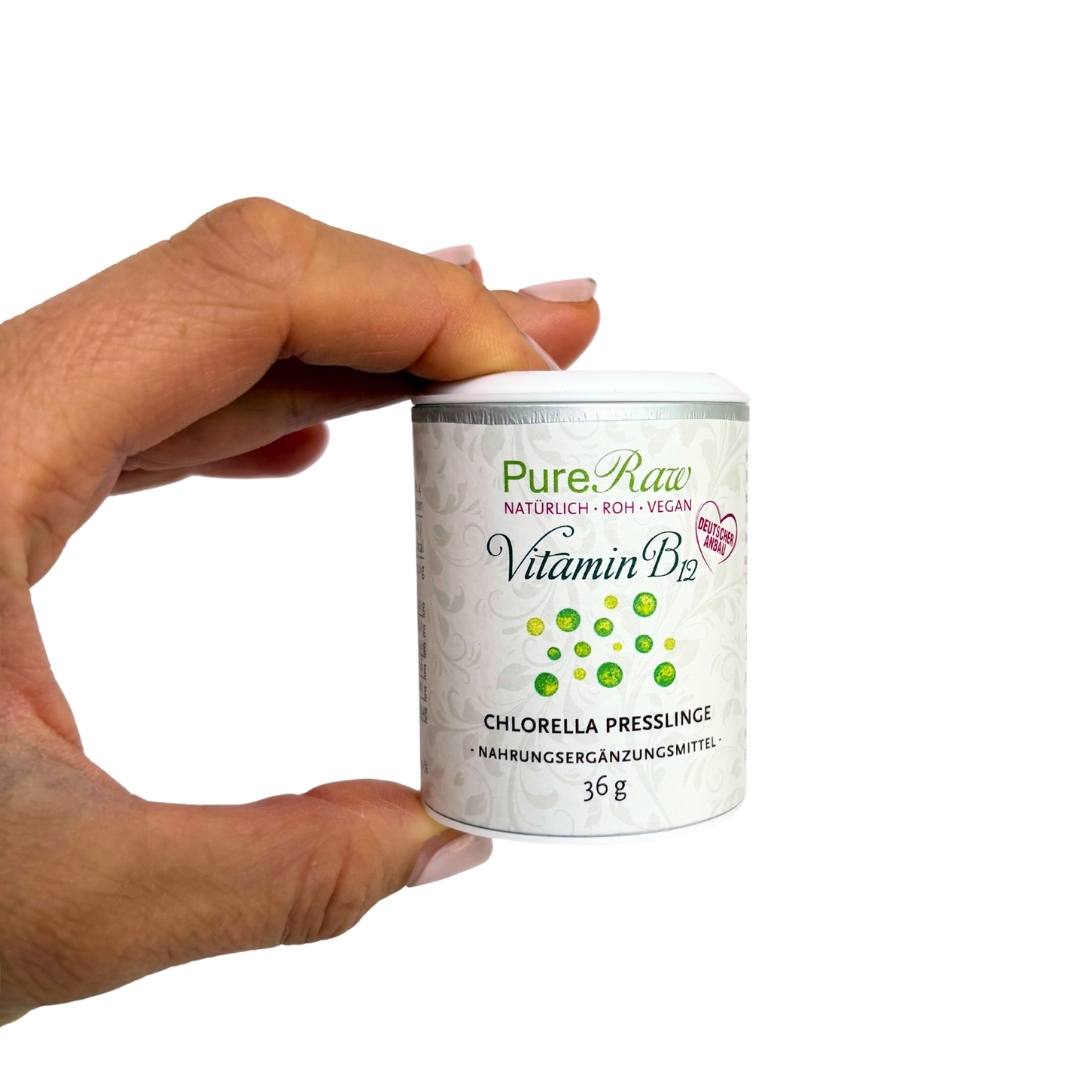
Our PureRaw Vitamin B12 Chlorella tablets are distinguished by their exceptionally high content of natural vitamin B12. For this purpose, particularly vitamin B12-rich chlorella harvests are selected in a sophisticated selection process. This results in a product with more than twice as much vitamin B12 as our regular German chlorella. Extensive laboratory analyses have also allowed the composition of the cobalamins contained to be determined more precisely for the first time. The total vitamin B12 content is 210 µg/100g and consists on average of: 76% adenosylcobalamin, 14% methylcobalamin (both biologically active forms of vitamin B12) and 10% hydroxocobalamin (which is converted by the body into the biologically active form).
Just 4 tablets daily provide you with 100% of the daily reference intake of vitamin B12. Vitamin B12 performs numerous important functions in the body:
-
Energy & reduced tiredness: Vitamin B12 contributes to normal energy metabolism as well as to the reduction of tiredness and fatigue.
-
Nervous system & mental function: Vitamin B12 contributes to the normal function of the nervous system and normal mental function.
-
Immune system: Vitamin B12 contributes to the normal function of the immune system.
-
Blood formation: Vitamin B12 contributes to the normal formation of red blood cells.
-
Cell division: Vitamin B12 plays a role in cell division.
-
Homocysteine metabolism: Vitamin B12 contributes to normal homocysteine metabolism.
General information about chlorella:
The Chlorella vulgaris is a single-celled, spherical freshwater microalga that is also affectionately known as the “green round one” due to its characteristic shape. With its intense green colour and natural nutrient profile, it is a popular addition to a conscious, plant-based diet.
Chlorella from Germany, cultivated in Klötze for over 20 years:
What makes our chlorella special is its origin: The algae are grown directly in Klötze in the Altmark, where PureRaw is also based. Microalgae have been cultivated here for over 20 years. The algae farm is now one of the largest of its kind in Europe.
Instead of growing in open ponds, our chlorella grows protected in a glass tube system over 500 km long. The special tube design allows for good exposure to natural sunlight while simultaneously protecting the cultures from external influences such as rain, dust or insects.
Pure water from over 45 metres deep:
Water from a private well fed by an aquifer at a depth of more than 45 metres is used for cultivation. Together with selected nutrients and our own chlorella starter cultures, it forms the basis for the controlled growth of the microalgae.
From cultivation to the finished product in Klötze:
The entire process is supervised on site: from our own starter cultures through cultivation and harvesting to the processing of the chlorella.
As soon as the microalgae are ready for harvest, they are separated from the water by means of centrifugation and then gently spray-dried. For our tablets, the chlorella powder is then formed without any additives. Regular quality and laboratory controls accompany production and ensure consistently high quality.
Naturally rich in spermidine:
Our chlorella is a particularly rich plant-based source of spermidine. This naturally occurring polyamine is also found in various foods and plays an important role in various biological processes in the body.
Recommended intake
Application
Nutritional values & ingredients of Vitamin B12, Chlorella Tablets
| Nährwert | per 100 g |
|---|---|
| Energy | 1585 kJ / 377 kcal |
| Fat | 9.3 g |
| of which saturates | 2.9 g |
| Carbohydrates | 9.2 g |
| of which sugars | 0.6 g |
| Protein | 51.9 g |
| Salt | 0.06 g |
| Vitamin B12 | 210 µg (8400 % NRV)* |
| Iron | 112 mg (800 % NRV)* |
****
| Nährwert | per daily dose 1.2 g (4 tablets) |
|---|---|
| Energy | 19 kJ / 5 kcal |
| Fat | 0.1 g |
| of which saturates | < 0.1 g |
| Carbohydrates | 0.1 g |
| of which sugars | < 0.1 g |
| Protein | 0.6 g |
| Salt | < 0.01 g |
| Vitamin B12 | 2.5 µg (100 % NRV)* |
| Iron | 1.3 mg (9 % NRV)* |
* Percent of the nutrient reference values (NRV)
Typische Zusammensetzung
| Bestandteil | per 100 g product |
|---|---|
| Total chlorophyll | 2.4 g |
| Total carotenoids | 170 mg |
| Lutein | 150 mg |
| Bestandteil | per 100 g product |
|---|---|
| Vitamin K | 33 µg |
| Vitamin B6 | 1 mg |
| Vitamin B9 (folate) | 610 µg |
| Vitamin B12 | 210 µg |
| Vitamin C | 19 mg |
| Vitamin E | 6 mg |
| Bestandteil | per 100 g product |
|---|---|
| Calcium | 316 mg |
| Potassium | 1496 mg |
| Magnesium | 318 mg |
| Iron | 112 mg |
| Zinc | 4 mg |
| Bestandteil | % of fatty acids |
|---|---|
| C16:0 palmitic acid | 25.2 % |
| C18:0 stearic acid | 2.6 % |
| C18:1 oleic acid | 5.2 % |
| C18:2 linoleic acid | 19.3 % |
| C18:3 α-linolenic acid | 30.7 % |
| Bestandteil | % of amino acids |
|---|---|
| Aspartic acid | 9.5 % |
| Threonine* | 5.0 % |
| Serine | 3.9 % |
| Glutamic acid | 11.9 % |
| Glycine | 6.0 % |
| Alanine | 9.0 % |
| Cysteine | 0.5 % |
| Methionine* | 2.2 % |
| Isoleucine* | 4.4 % |
| Leucine* | 9.5 % |
| Tyrosine | 3.5 % |
| Phenylalanine* | 6.1 % |
| Lysine* | 8.1 % |
| Histidine* | 2.0 % |
| Arginine | 6.5 % |
| Proline | 5.3 % |
| Tryptophan* | 2.4 % |
| Valine* | 6.6 % |
* Essential amino acids
Important notes
Frequently asked questions about Vitamin B12, Chlorella Tablets

Does chlorella contain spermidine?
Yes - and in impressive amounts. While wheat germ, soybeans and pumpkin seeds are valued as natural sources of spermidine, chlorella contains many times their amounts at around 630 - 1000 mg/kg, making it a particularly rich plant-based source. The daily dose of 3 g of chlorella contains approx. 2-3 mg of spermidine.
You can find out more about chlorella and spermidine in our product knowledge section.
Which form of vitamin B12 does PureRaw chlorella contain?
Only bioavailable forms were detected in our chlorella: a mixture of adenosylcobalamin (approx. 76 %) + methylcobalamin (approx. 14 %) (both active as vitamins) and traces of hydroxocobalamin (approx. 10 %) (converted by the body into the active vitamin form).
- You can find out more about chlorella and vitamin B12 in our product knowledge section.
Recommended articles for further reading:
- Paracelsus Magazin. (2015). Algen als natürliche Vitamin-B12-Quelle (issue 3/2015). Deutsche Paracelsus Schulen. Accessed on 18 March 2021
Why is the German chlorella not certified organic?
Since the end of 2015, the EU organic regulation has in principle allowed organic certification of microalgae. However, this process is demanding because it requires specific substrates (fertilizers). After thorough examination, we found that some of these substrates are either not vegan or do not meet our high quality criteria. We would also like to stress that transporting fertilizers such as guano around the world is neither vegan nor ideal for the algae, and does not meet our sustainability standards.
Despite the possibility of having our microalgae certified organic, we have decided against it for the time being. This step serves to make sure that all the substrates and processes we use meet our own strict quality standards. Your health and satisfaction, as well as the high quality standard of our algae, come first for us.
How should chlorella be taken together with spirulina?
As a general rule, chlorella and spirulina should be taken at least 30 minutes apart if the aim is to absorb vitamin B12 from our German chlorella as efficiently as possible.
Is Chlorella pyrenoidosa or Chlorella vulgaris better?
Research on algae has developed rapidly over the past 20 years and has also made progress in analysis and identification methods.
It has been known since 1992 that the former does not exist at all. It is therefore an outdated scientific name.
Since extensive studies that were revolutionary at the time, we know which chlorella species exist and that, for example, the aforementioned Chlorella pyrenoidosa (which used to be described frequently) does not exist (Kessler E. & Huss V.A.R., 1992; Huss V.A.R. et al., Krienitz et al., 2004). In the past, a distinction was therefore made between Chlorella vulgaris and Chlorella pyrenoidosa, and different properties were attributed to them. However, it had already become clear in 1992 that Chlorella pyrenoidosa does not exist as a species.
Do the cell walls of chlorella have to be broken?
In fact, studies have found no significant increase in bioavailability through micronization, i.e. breaking open the cell membranes. The drying method is far more important. Tray dryers used to be common. Spray drying, however, has significantly increased digestibility. It is also little known that chlorella with broken cell walls binds heavy metals less well than the intact variant.
You can find out more about chlorella and broken cell walls here: Ullmann, J. (2013, May 1). Die Welt der Algen: Fakten, Mythen und Geschichten. Das Weblog von Jörg Ullmann. Accessed on 18 March 2021
How much chlorella can I take per day?
Recommended intake: about 1 g per 25 kg of body weight.
What do I need to bear in mind when taking chlorella for the first time?
Start with a small daily dose and gradually increase it to the recommended amount. The dosage of chlorella can be adjusted to individual needs.
Does chlorella contain sugar?
The sugar content shown in the nutritional information is not added sugar. These are natural plant constituents. Sugar is a product of photosynthesis and is found in all plants.
Is salt added to the chlorella in the glass tubes?
No, no salt (sodium chloride) is used to cultivate the chlorella algae.
Rezepte & mehr zu Vitamin B12, Chlorella Tablets


