




About Amla / Amalaki Powder (Organic) 40 g
Do you know Amalaki? The small, light yellow fruit, also known as amla or Indian gooseberry, has been valued in traditional Ayurvedic diets for centuries. It grows on the amla tree (Phyllanthus emblica), which is primarily native to the tropical and subtropical regions of Asia.
What makes Amalaki special is its natural composition. The fruits contain polyphenols, tannins, and other secondary plant compounds. Vitamin C is also one of the natural components of fresh amla fruit, as scientific studies show.[1,2,3]
In the Ayurvedic tradition, Amalaki is also an important ingredient in well-known formulations such as Triphala and Chyavanprash.
For our Organic Amalaki Powder, the fruits are gently dried and finely ground. This creates an unadulterated fruit powder with a characteristic, pleasantly tart and slightly bitter taste. It can be easily stirred into smoothies, juices, yogurt, or other foods.
Sources:
1. Orabi, M. A. A. et al. (2023). Nutritional, Antioxidant, Antimicrobial, and Anticholinesterase Properties of Phyllanthus emblica: A Study Supported by Spectroscopic and Computational Investigations. Metabolites, 13(9), 1013. DOI: 10.3390/metabo13091013.
2. Gul, M. et al. (2022). Functional and Nutraceutical Significance of Amla (Phyllanthus emblica L.): A Review. Antioxidants, 11(5), 816. DOI: 10.3390/antiox11050816.
3. Abeysuriya, H. I., Bulugahapitiya, V. P. & Loku Pulukkuttige, J. (2020). Total Vitamin C, Ascorbic Acid, Dehydroascorbic Acid, Antioxidant Properties, and Iron Content of Underutilized and Commonly Consumed Fruits in Sri Lanka. International Journal of Food Science, 2020, 4783029. DOI: 10.1155/2020/4783029.
Recommended intake
Application
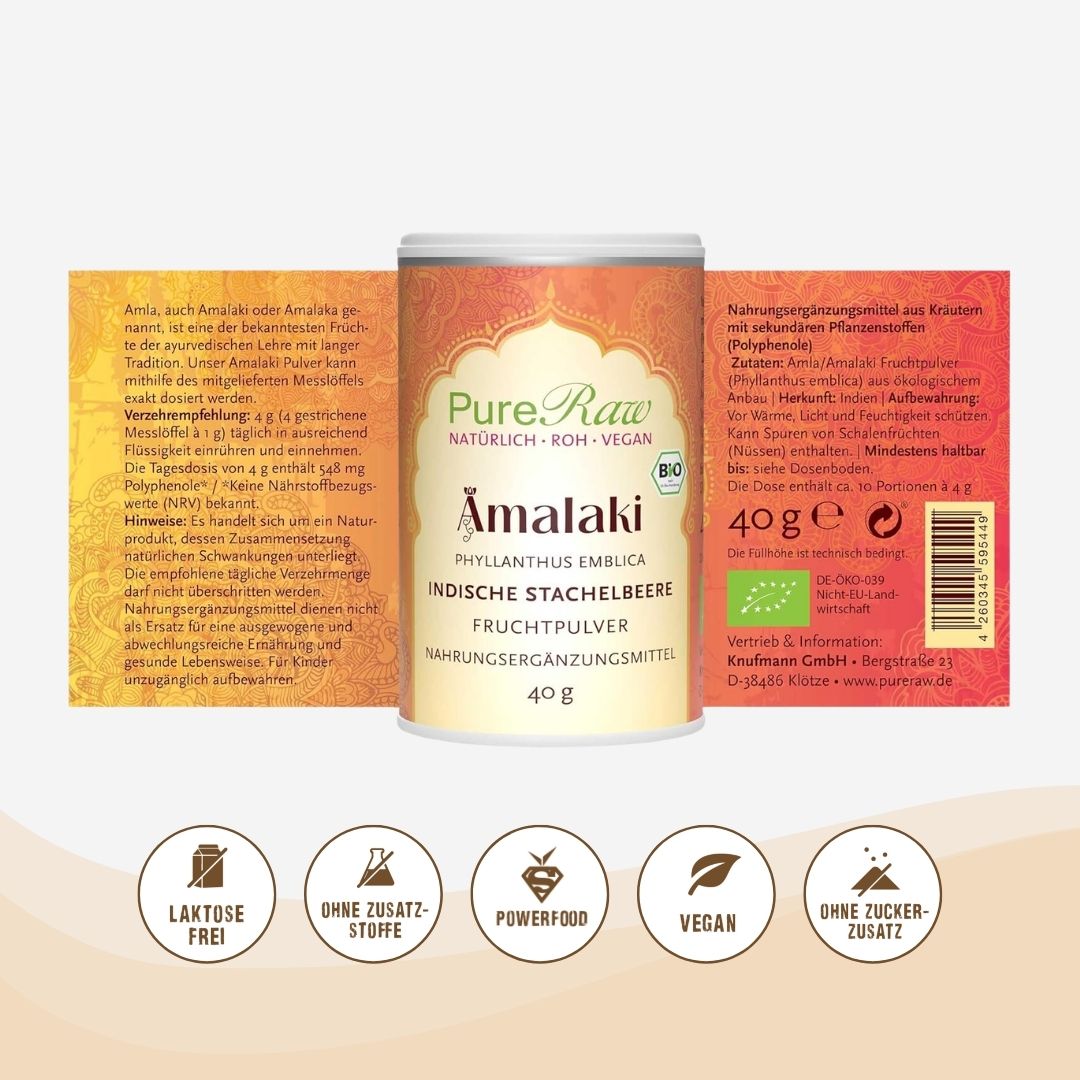
Nutritional values & ingredients of Amla / Amalaki Powder (Organic) 40 g
| Nährwert | per 4 g daily serving |
|---|---|
| Polyphenols | 548 mg** |
** No nutrient reference values (NRV) known
Important notes
Frequently asked questions about Amla / Amalaki Powder (Organic) 40 g

Rezepte & mehr zu Amla / Amalaki Powder (Organic) 40 g

-21%
3 für 2


