




About Organic Dulse
Dulse, also known as dillisk, is a red alga with the botanical name Palmaria palmata. It is known for its strong, savory, slightly nutty taste, which is often reminiscent of a subtle bacon flavor.
Our Dulse is harvested by hand in its natural habitat. It comes from the coasts of western Ireland and/or Brittany in the western English Channel.
After harvesting, the alga is carefully washed and then gently dried at low temperatures below 38 °C. No further processing steps or additional treatments take place. Through this minimal processing, the natural properties of the alga are preserved as best as possible, and its raw food quality is maintained.
With its hearty, aromatic flavor, Dulse is versatile, ideal for seasoning, refining, and as a special topping for salads, bowls, soups, pasta, or vegetable dishes.
Recommended intake
Application
Nutritional values & ingredients of Organic Dulse
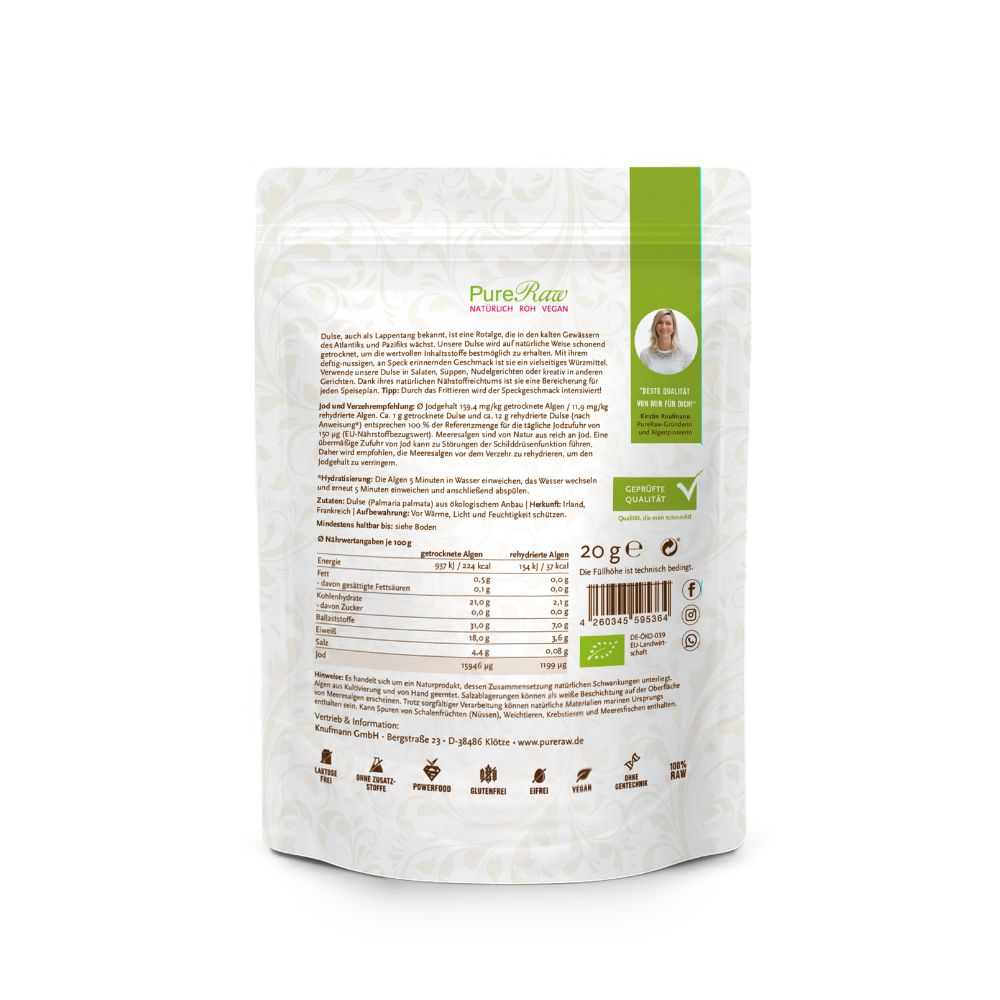
| Nährwert | per 100 g dried seaweed |
|---|---|
| Energy | 937 kJ / 224 kcal |
| Fat | 0.5 g |
| of which saturates | 0.1 g |
| Carbohydrate | 21.0 g |
| of which sugars | 0.0 g |
| Fibre | 31.0 g |
| Protein | 18.0 g |
| Salt | 4.4 g |
| Iodine | 15946 μg |
****
| Nährwert | per 100 g rehydrated seaweed |
|---|---|
| Energy | 154 kJ / 37 kcal |
| Fat | 0.0 g |
| of which saturates | 0.0 g |
| Carbohydrate | 2.1 g |
| of which sugars | 0.0 g |
| Fibre | 7.0 g |
| Protein | 3.6 g |
| Salt | 0.08 g |
| Iodine | 1199 μg |
Important notes
Frequently asked questions about Organic Dulse

Was ist Dulse?
Dulse ist eine Rotalge mit dem botanischen Namen Palmaria palmata. Sie wird auch Lappentang genannt und ist für ihren kräftig-würzigen, leicht nussigen Geschmack bekannt.
Woher stammt die PureRaw Dulse?
Unsere Dulse wird von Hand in ihrem natürlichen Lebensraum geerntet. Sie stammt von den Küsten Westirlands und/oder der Bretagne im westlichen Ärmelkanal.
Ist die Dulse Rohkost?
Ja. Nach der Ernte wird die Dulse sorgfältig gewaschen und anschließend bei Temperaturen unter 38 °C schonend getrocknet. Weitere Verarbeitungsschritte oder zusätzliche Behandlungen finden nicht statt. Dadurch behält sie ihre Rohkostqualität.
Wie schmeckt Dulse?
Dulse schmeckt kräftig-würzig und leicht nussig. Ihr charakteristisches Aroma wird häufig mit einer feinen, an Speck erinnernden Note beschrieben.
Wie kann ich Dulse verwenden?
Dulse eignet sich vielseitig zum Würzen und Verfeinern. Du kannst sie zum Beispiel für Salate, Bowls, Suppen, Pasta, Gemüsegerichte oder als Topping verwenden. Besonders aromatisch schmeckt sie auch kurz knusprig angebraten.
Enthält Dulse Zusatzstoffe?
Nein. Unsere Dulse besteht aus 100 % getrockneter Dulse und kommt ohne Zusatzstoffe aus.
Enthält Dulse Jod?
Meeresalgen enthalten von Natur aus Jod. Bitte beachte deshalb die Hinweise und Verzehrempfehlungen auf der Verpackung.
Wie sollte Dulse gelagert werden?
Lagere die Dulse trocken, kühl und vor direkter Sonneneinstrahlung geschützt. Nach dem Öffnen sollte die Verpackung immer gut verschlossen werden.
Was ist der weiße Belag auf den Algen?
Ein heller oder weißlicher Belag kann natürlicherweise auf getrockneten Algen auftreten. Dabei handelt es sich meist um ausgetretene natürliche Bestandteile und Meersalze. Dies ist kein Hinweis auf Schimmel.
How is microplastic contamination of the seaweeds monitored?
The harvesting areas of our seaweeds are officially monitored and regularly inspected. This includes testing water quality and environmental conditions in order to detect possible contamination at an early stage.
In addition, before being released for consumption, the seaweeds are regularly tested for unwanted contaminants. Modern analytical methods are used that can detect even very small particles.
If conspicuous contamination is found in a harvesting area, collection there can be suspended or stopped. Controlled harvesting, regular analyses and continuous quality checks minimize the risk of contamination as far as possible.
Rezepte & mehr zu Organic Dulse


