




Der Yacon Snack ist mit seiner natürlichen Süße richtig lecker. Da fällt es mir schwer, aufzuhören :-)
Weil der Yacon Snack so lecker ist, ist er leider schneller weg als mir lieb ist ;-)
Free shipping on orders over 100 EUR!


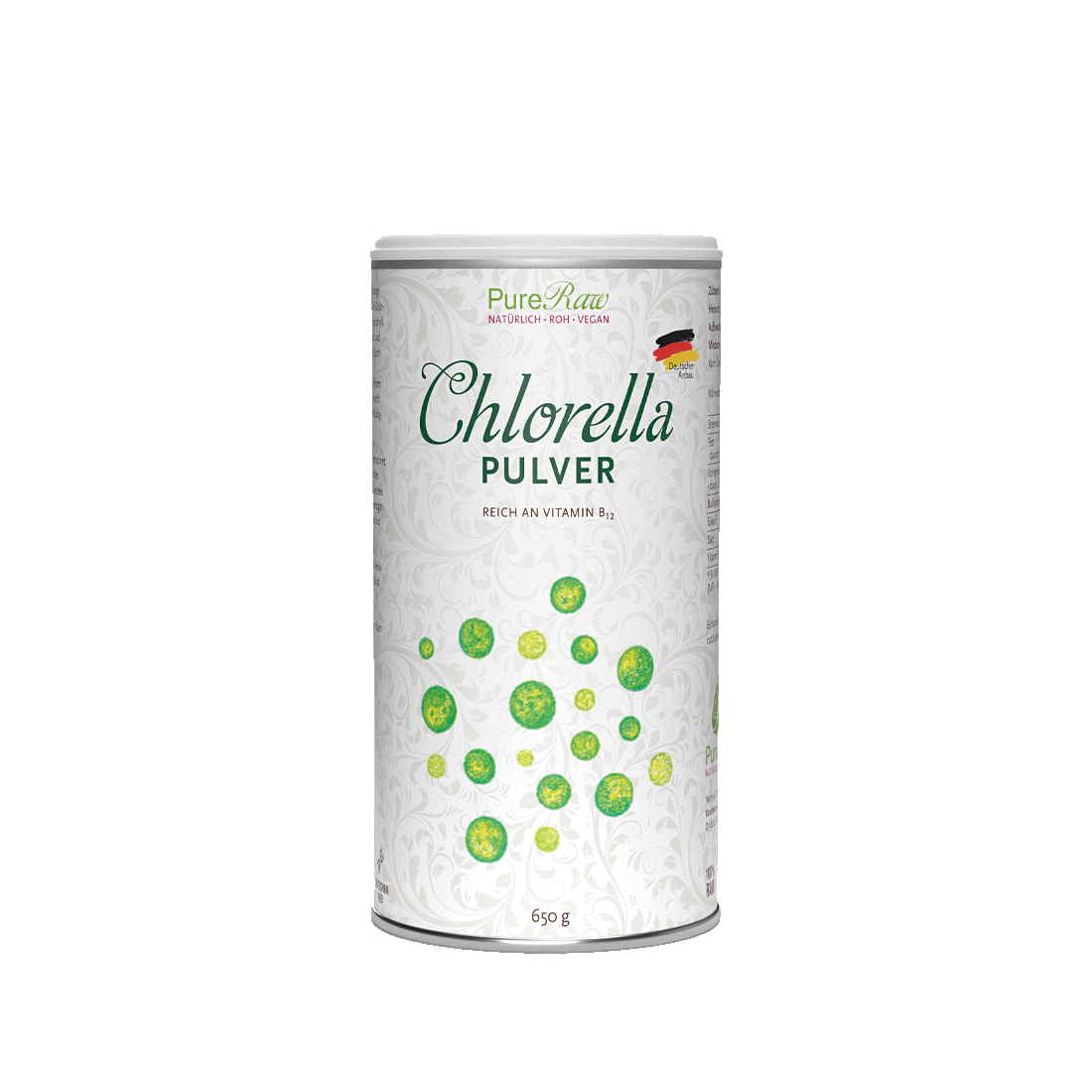
Chlorella
Total chlorophyll: 2.4 g
Total carotenoids: 170 mg
Lutein: 150 mg
Vitamin K: 33 µg
Vitamin B6: 1 mg
Vitamin B9 (Folic Acid): 610 µg
Vitamin B12: 100 µg
Vitamin C: 19 mg
Vitamin E: 6 mg
Calcium: 316 mg
Potassium: 1496 mg
Magnesium: 318 mg
Iron: 112 mg
Zinc: 4 mg
C16:0 Palmitic acid: 25.2 %
C18:0 Stearic acid: 2.6 %
C18:1 Oleic acid: 5.2 %
C18:2 Linoleic acid: 19.3 %
C18:3 α – Linolenic acid: 30.7 %
Aspartic Acid: 9.5 %
Threonine*: 5.0 %
Serine: 3.9 %
Glutamic Acid: 11.9 %
Glycine: 6.0 %
Alanine: 9.0%
Cysteine: 0.5%
Methionine*: 2.2%
Isoleucine*: 4.4%
Leucine*: 9.5%
Tyrosine: 3.5%
Phenylalanine*: 6.1%
Lysine*: 8.1%
Histidine*: 2.0%
Arginine: 6.5%
Proline: 5.3%
Tryptophan*: 2.4%
Valine*: 6.6%
* Essential amino acids
Answers on Chlorella & Co.
Since the end of 2015, the EU Organic Regulation has generally allowed for the
organic certification of microalgae. However, this process is challenging as it
requires specific substrates (fertilizers). After extensive testing, we have
found that some of these substrates are either not vegan or do not meet our high
quality criteria. Additionally, we want to emphasize that transporting
fertilizers such as guano around the world is neither vegan nor optimal for the
algae, and does not meet our sustainability standards.
Despite the possibility of
having our microalgae organically certified, we have decided against it for the
time being. This step ensures that all substrates and processes we use comply
with our own strict quality standards. Your health and satisfaction, as well as
the high quality standard of our algae, are our top priority.
Only bioavailable forms could be detected in our Chlorella: a mixture of adenosylcobalamin (approx. 76%) + methylcobalamin (approx. 14%) (both vitamin-active) and traces of hydroxocobalamin (approx. 10%) (converted by the body into the vitamin-active form).
- Learn more about Chlorella and Vitamin B12 in our product knowledge section.
Recommended articles for further reading:
- Paracelsus Magazine. (2015). Algae as a natural source of vitamin B12 (Issue 3/2015). Deutsche Paracelsus Schulen. Accessed on 18/03/2021
As a general rule, chlorella and spirulina should be taken at least 30
minutes apart for the most efficient absorption of vitamin B12 from our German chlorella.
The new packaging is made of a mono-plastic that is
BPA-free and 100% recyclable. The inside of the
Chlorella bag is colored to provide a familiar metallic
shimmering effect. Even though it looks like it, the packaging is
100% aluminum-free.
This packaging material is particularly
suitable for food products and ensures a long shelf life. It
protects the product from UV radiation (light), moisture, and loss of aroma.
In addition, this type of packaging offers many other advantages, such as
better protection during transport and lighter transport weight,
thereby reducing CO2 emissions.
Yes - and in impressive quantities. While wheat germ, soybeans, or pumpkin seeds are valued as natural sources of spermidine, chlorella contains many times their amounts, with approximately 630 - 1000 mg/kg, making it a particularly rich, plant-based source. The daily dose of 3 g chlorella contains approximately 2-3 mg of spermidine.
- Learn more about chlorella and spermidine in our product knowledge.
In the field of algae, research has developed rapidly in the last 20 years and
made progress also in analysis/determination methods.
Since 1992, it has been known that the former does not exist at all. It is
therefore an outdated scientific term.
Since extensive and at that time revolutionary investigations, it is known
which Chlorella species exist and that, for example, the aforementioned Chlorella
pyrenoidosa (which was often described earlier) does not exist (Kessler E. &
Huss V.A.R., 1992; Huss V.A.R. et al., Krienitz et al., 2004).
Previously, Chlorella vulgaris was distinguished from Chlorella pyrenoidosa, and
different properties were attributed to them. In 1992, however, it was already
shown that Chlorella pyrenoidosa does not exist as a species.
In fact, studies have not shown any significant increase in bioavailability
through micronization, i.e., breaking down cell membranes.
Much more important is the type of drying. Previously, tray dryers were common.
However, spray drying significantly increased digestibility.
It is also little known that chlorella with broken cell walls
binds heavy metals less effectively than the intact variant.
- Learn more
about Chlorella and broken cell walls here:
Ullmann, J. (2013, May 1). The World of Algae: Facts, Myths and
Stories. Jörg Ullmann's Weblog. Accessed on: 18.03.2021
Recommended intake: Approx. 1 g per 25 kg body weight.
Start with a low daily dose and gradually increase it to the recommended amount. The dosage of Chlorella can be adjusted to individual needs.
The sugar content in the nutritional information is not added sugar. These are
natural plant ingredients. Sugar is a product of photosynthesis and can be
found in all plants.
No, salt (sodium chloride) is not used for the cultivation of chlorella algae.
Since Chlorella is a freshwater algae, there is no iodine source in the medium and therefore no iodine can be enriched there. Iodine is only present in trace amounts.
As we are hardly allowed to make any statements on this, we recommend reading
the special issue 04/2017 "The Microalga Chlorella" by "Die Naturheilkunde" from
Forum Medizin Verlag, in which diploma biologist and algae specialist Jörg
Ullmann from the algae farm in Klötze discusses the state of scientific
knowledge on Chlorella and its effective mechanisms of action to support natural
detoxification. The article discusses, among other things, Chlorella species; the
potential of microalgae to mobilize, bind, and excrete harmful substances such
as dioxins, pesticides, or heavy metals like lead, mercury, or arsenic;
contained antioxidants and the antioxidant potential; effect on the immune
system; and quality criteria of Chlorella products. Many fundamental questions
about Chlorella that repeatedly arise are also answered here, and false
information that causes confusion is clarified. Some examples can be found on
this page. Much information can also be found in the author's blog "Die Welt der
Algen" (The World of Algae).
- Learn more about Chlorella and its benefits
here:
Ullmann, Jörg. "The Microalga Chlorella – Effective
Mechanisms of Action to Support Natural Detoxification", Die Naturheilkunde,
Special Print from Issue 4/2017, Forum Medizin, ISSN 1613-3943, 94th Year.
Accessed on: 15.05.2018
Nitrogen (chemical element: N) is one of the so-called macronutrients
that every plant, including algae, absolutely needs to live and grow, for
example, as a building block for the amino acids of proteins or chlorophyll.
Here, it is added to the water in the form of easily soluble nitrate (NO3)
and completely absorbed and metabolized by the algae.
Like any other plant, chlorella needs specific micro- and macronutrients to grow, which we add to the cultivation medium in a targeted and optimized amount (for the algae). Most of these nutrients are "consumed" by the algae, meaning they are converted into growth and thus into biomass.
Our chlorella grows under natural conditions, meaning that during its growth, the normal natural accompanying flora is present. Just as on any lettuce leaf, carrot, or apple, for that matter. If the algae is thriving, which we ensure with great effort, then the product does not need special treatment and is safe.
Potential biofilms are, on the one hand, part of our monitoring and, on the other hand, the tubes are cleaned regularly.
Glass primarily filters UV light, which algae do not need for their photosynthesis.
In nature, algae grow in water or just below the water surface. Similar to glass, water also filters UV light, so algae are accustomed to these exact light conditions.
Other manufacturers cultivate chlorella partly in fermenters (completely without light) or in open ponds. There, light only hits the culture from above and barely penetrates deep, leading to uneven light supply.
In a glass tube system, the culture is continuously mixed. This ensures that all algae cells receive sunlight evenly, providing optimal conditions for healthy growth.


